Company Vehicle Accident After Hours: Who Pays, Who Gets Fired, and What GPS Data Proves
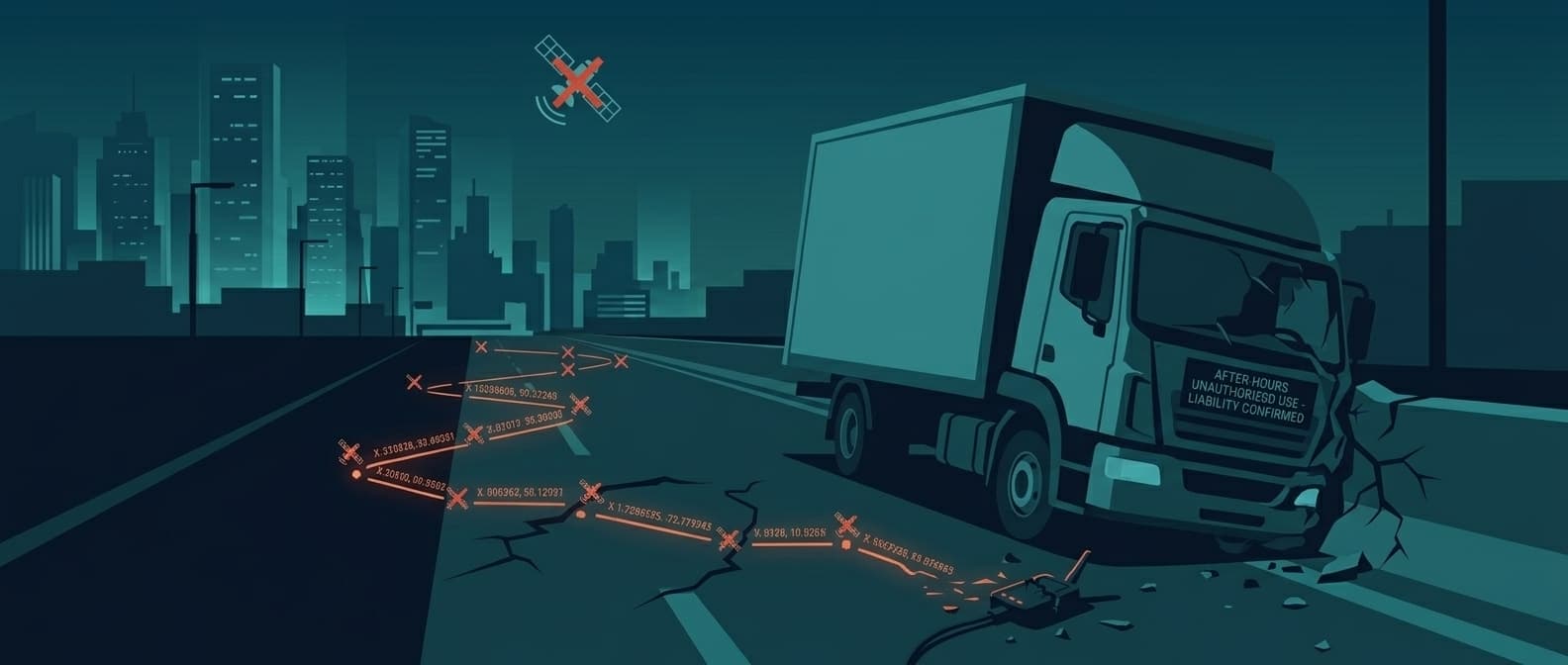
It's 11 PM on a Saturday. One of your employees is behind the wheel of a company truck. They blow through a red light and hit another vehicle. The other driver is taken to the hospital with a broken collarbone and herniated disc.
The victim's attorney files a lawsuit on Monday. Your company is named as a defendant. Your employee is named individually. Your commercial auto insurer receives the claim.
The question that will determine whether your company pays $500,000 or nothing: did you know the employee was using the truck for personal purposes?
And the evidence that answers that question, increasingly, is GPS data from fleet tracking systems.
The Legal Doctrine That Decides Everything
Two Latin phrases control who pays when an employee causes an accident in a company vehicle: respondeat superior and negligent entrustment. Both sound academic. Both cost companies millions of dollars every year.
Respondeat Superior
This doctrine says employers are liable for the actions of employees performed within the scope of employment. If a delivery driver hits a pedestrian while making a delivery, the employer pays. The driver was doing their job. The employer benefits from the activity that caused the harm. The employer bears the cost.
The critical question is always scope. Was the employee acting within the scope of employment at the time of the accident?
Courts apply a multi-factor test. The specifics vary by state, but the common elements are:
- Was the employee performing work duties or something incidental to work?
- Did the employer authorize the activity (expressly or impliedly)?
- Was the conduct foreseeable given the nature of the employment?
- Did the employer exercise control over the activity?
If the answer to most of these is yes, the employer is on the hook. If the employee was doing something entirely personal and unrelated to work, the employer may escape liability.
Negligent Entrustment
Even when the employee was clearly off the clock and outside the scope of employment, the company can still be liable under negligent entrustment. This doctrine says: if you give a dangerous instrumentality (like a 6,000-pound truck) to someone you know or should know is unfit to operate it safely, you're liable for the resulting damage.
This applies when:
- The employee has a history of DUI/DWI convictions
- The employee's MVR shows multiple at-fault accidents or moving violations
- The employer failed to conduct a background check before handing over the keys
- The employer knew the employee was using the vehicle recklessly and did nothing
A Georgia court awarded $1.2 billion (later reduced to $40 million) against a trucking company under negligent entrustment when a driver caused a fatal crash. The key evidence: the company knew the driver had a history of falsifying logs and exceeding hours-of-service limits.
Scale that down to a small fleet. If your employee has two speeding tickets and a careless driving conviction on their MVR, and you never checked, a jury will ask why you gave them a truck.
When the Employer IS Liable
The default position in most states is that the employer is liable for accidents involving company vehicles unless the employer can prove the use was unauthorized. These are the situations where courts consistently rule against the company.
The "Coming and Going" Rule Exceptions
The general rule is that employees commuting to and from work are not within the scope of employment. But this rule has so many exceptions it barely functions as a rule.
Take-home vehicle exception. If you allow employees to take company vehicles home, most courts treat the commute as within the scope of employment. The reasoning: the employer chose to provide a vehicle, the employee's use of it for commuting benefits the employer (ready access to the vehicle), and the employer maintains control over the vehicle. California, New York, Texas, and Florida all follow some version of this.
Dual-purpose trip exception. If the employee is combining a personal errand with a business purpose, the trip is typically within scope. Stopping for groceries on the way back from a job site does not remove the employee from the scope of employment.
Employer-required commute. If the employee must bring the vehicle home because they're on call, or because they need to respond to emergencies, the commute itself becomes a work duty.
Frolic vs. Detour
This is the distinction that separates "the company pays" from "the employee pays."
A detour is a minor, temporary departure from work duties. Stopping for lunch. Getting gas at a station that's a few blocks off the normal route. Running a quick personal errand during a break. Courts generally hold employers liable during detours because the employee is still broadly performing work functions.
A frolic is a substantial departure from employment for purely personal reasons. Driving the company truck to a concert 50 miles away on a Saturday night. Taking a company van on a weekend camping trip. Using the work truck to move a friend's furniture on a day off.
During a frolic, the employer is generally not liable, because the employee has abandoned the employer's business entirely.
The problem: frolic vs. detour is a fact-intensive question decided by juries. Reasonable people disagree about where the line falls. And when a jury is looking at an injured plaintiff and a corporate defendant, sympathy often fills in the gaps.
Implied Permission
Your written policy might say "no personal use." But if you've known for months that employees drive company trucks home every night, take them on weekends, and use them for personal errands, and you've never enforced the policy, a court may find implied permission.
Implied permission destroys the "unauthorized use" defense. The policy on paper says one thing. The actual practice says another. Courts look at actual practice.
This is where GPS data becomes essential. If you can show that you actively monitor vehicle use and enforce your policy when violations occur, you defeat the implied permission argument. If you have a policy but no enforcement mechanism, the policy is legally useless.
When the Employer Is NOT Liable
Companies can protect themselves, but only with a combination of written policy, documented enforcement, and evidence. These are the conditions where courts have found the employer not liable.
Clear Written Policy Against Personal Use
A written vehicle use policy that explicitly prohibits personal use, signed by the employee, is the starting point. Without this, every other defense weakens substantially.
The policy must be:
- Specific. "No personal use" needs to be defined. Personal use means any trip not directly related to assigned job duties, including commuting if applicable.
- Signed. Every employee with vehicle access signs an acknowledgment. Annually, not just at onboarding.
- Distributed. Given to the employee, not just stored in an HR filing cabinet.
- Current. Reviewed and updated annually.
Documented Enforcement History
A policy you never enforce is worse than having no policy at all. If you discipline employees for violations, document those actions. Written warnings, suspension of vehicle privileges, and termination records all show a court that the company meant what it wrote.
GPS Evidence of Unauthorized Use
This is the strongest defense available to fleet operators in 2026. GPS tracking data showing that the vehicle was outside authorized zones, moving during prohibited hours, and located far from any work site is hard evidence that the employee was on a frolic, not a detour.
In Riley v. Lowe's Home Centers (2018), GPS data from a fleet management system showed a company vehicle was 14 miles from any store location at the time of an accident, traveling in the opposite direction of the employee's assigned route. The court found the employee was outside the scope of employment. Lowe's was dismissed from the case.
In Patterson v. Blair (2019, Alabama), fleet GPS records proved that a company truck was being driven at 2 AM on a Sunday, 40 miles from the employee's home or any work site. The court ruled this was a frolic as a matter of law. The employer was not liable.
Without GPS data, these cases become credibility contests between the employee's account ("I was heading to an early morning job site") and the plaintiff's attorney's theory ("He was out drinking"). GPS eliminates the ambiguity.
How GPS Data Becomes the Deciding Evidence
In company vehicle accident litigation, GPS data from fleet tracking systems is now routinely subpoenaed, produced in discovery, and introduced as evidence. Both sides use it.
What GPS Data Proves
Location at time of accident. Was the vehicle at or near a work site, on a known route between work locations, or somewhere entirely personal? This is the single most important data point for the respondeat superior analysis.
Time of travel. An employee driving at 11 PM on a Saturday carries a very different legal implication than the same employee driving at 2 PM on a Tuesday. After-hours travel, especially on weekends and holidays, strongly suggests personal use.
Route deviation. GPS breadcrumb trails show the path the vehicle took. If the employee was driving from Job Site A to Job Site B and deviated 2 miles for a coffee stop (detour), that's different from being 30 miles off-route heading toward a social event (frolic).
Pattern of personal use. Attorneys look at not just the day of the accident, but weeks or months of location history. If the data shows the employee routinely drove the company truck for personal errands every weekend and the employer never intervened, that supports an implied permission argument.
Speed and movement patterns. Some fleet systems log speed data. If the employee was doing 65 in a 35 zone, that's relevant to the negligence claim even if it doesn't change the scope-of-employment analysis.
How Plaintiff Attorneys Use Your GPS Data Against You
If your GPS data shows the employee regularly used the company vehicle after hours and you never acted on it, a plaintiff's attorney will argue:
- You knew. The data was in your system. You had constructive knowledge of the personal use.
- You allowed it. By failing to act on what you knew, you impliedly authorized the personal use.
- The employee was within scope. Because the personal use was known and tolerated, it became an incident of employment.
This is why having GPS data is not enough. You need GPS data plus a documented response to violations. The data without enforcement hurts you more than no data at all.
The Insurance Coverage Gap
This is the part that bankrupts small fleet operators who think their commercial auto policy covers everything.
What Commercial Auto Policies Actually Cover
Standard commercial auto policies cover vehicles used for business purposes. The policy language varies, but most policies define covered use as:
- Travel to and from work locations
- Travel between work sites
- Travel incidental to business operations
- Use by authorized drivers for authorized purposes
Personal use by employees during non-business hours is often excluded or subject to specific endorsements that many fleet managers never add.
What Happens When the Insurer Denies the Claim
If your employee causes a $400,000 accident during personal use and your insurer determines the vehicle was being used outside the policy terms, the denial letter looks something like this:
"The loss occurred during personal, non-business use of the covered vehicle, which is excluded under Section III(B)(4) of your policy. Coverage is respectfully declined."
Now your company is self-insured for the entire claim. No defense counsel provided by the insurer. No indemnity coverage. Just a $400,000 (or more) exposure sitting on your balance sheet.
The Employee's Personal Auto Policy Won't Help Either
Personal auto insurance policies contain a standard exclusion for vehicles "furnished or available for the regular use" of the insured. A company truck that the employee drives daily is clearly furnished for regular use. The employee's personal policy won't cover an accident in a company vehicle.
So neither policy covers the gap. The commercial policy excludes personal use. The personal policy excludes company vehicles. The result is no coverage from either direction.
What to Do About It
Option 1: Add a personal use endorsement. Ask your insurance broker about adding coverage for permissive personal use. This typically costs 10-20% more on the premium, but it closes the gap.
Option 2: Prohibit personal use and enforce it. If your policy prohibits personal use and you enforce it with GPS monitoring, you reduce the likelihood of an uncovered claim. You also strengthen your position if the insurer tries to deny coverage for an isolated unauthorized use.
Option 3: Require employees to carry non-owned auto insurance. This provides some coverage when an employee drives a vehicle they don't own. It's not a complete solution, but it adds a layer.
Talk to your broker. Ask the specific question: "If one of our employees gets into an accident during unauthorized personal use of a company vehicle after hours, are we covered?" Get the answer in writing.
The Personal Use Policy Every Fleet Needs
If you take one thing from this article, it's this: a written vehicle use policy, signed by every employee with vehicle access, is the single most important legal document your fleet operation can have.
Core Provisions
1. Authorized use definition. Define exactly what constitutes authorized use. List the types of trips that are approved: travel to job sites, travel between job sites, travel to supply houses, client visits. Everything else is unauthorized.
2. Personal use prohibition. State plainly: company vehicles may not be used for personal purposes. Define personal purposes to include commuting (unless specifically authorized), errands, social activities, recreation, and any trip not directly related to assigned job duties.
3. After-hours restrictions. Specify that vehicles must be parked at approved locations (company yard, designated parking area, or employee's home if take-home is authorized) by a specific time. Any movement outside approved hours requires prior written authorization from a supervisor.
4. GPS monitoring disclosure. State that all company vehicles are equipped with GPS tracking devices, that vehicle location, movement, and mileage are monitored, and that this data may be used for policy enforcement, insurance documentation, and legal proceedings.
5. Consequences. First violation: written warning and counseling. Second violation: 30-day suspension of vehicle privileges. Third violation: termination. Severe violations (DUI, hit-and-run, reckless driving): immediate termination.
6. Annual acknowledgment. Every employee with vehicle access signs the policy annually. HR maintains the signed copies.
How Airpinpoint Geofencing Creates the Evidence Trail
Setting up a vehicle use policy is step one. Proving you enforce it is step two. Airpinpoint's geofencing gives you the enforcement mechanism and the evidence trail in one system.
The Setup
For each fleet vehicle, create geofences around:
- Company yard or office where vehicles are stored
- Active job sites (add and remove as projects start and end)
- Employee home addresses (for take-home vehicles)
Set time-based alert rules: any movement outside geofenced areas after business hours triggers an email or webhook notification.
What This Creates
Real-time violation alerts. A company truck leaves the employee's home at 10 PM on a Friday. You get an email within minutes. You can address it Monday morning with documentation that includes the timestamp, location, and duration of the unauthorized movement.
A documented enforcement history. Every alert, every conversation with the employee, every written warning goes in the file. When a plaintiff's attorney asks "Did you know your employee used the truck for personal purposes?", you can answer: "We detected every instance, addressed every instance, and disciplined employees according to our written policy."
An insurance defense. If your insurer tries to deny a claim based on personal use, your geofencing records show that you had a system in place to prevent and detect unauthorized use. The one incident that resulted in an accident was a violation of your enforced policy, not an accepted practice.
A litigation defense. GPS data showing the vehicle's location, the geofence boundaries, and the violation history is admissible evidence. It converts the scope-of-employment question from a subjective credibility contest into an objective data analysis.
Cost vs. Exposure
Airpinpoint's Business plan costs $11.99 per vehicle per month. For a 15-vehicle fleet, that's $180 per month or $2,160 per year.
The average verdict in a company vehicle accident case involving serious bodily injury ranges from $250,000 to $1.5 million. Defense attorney fees for litigating a single case through trial average $75,000 to $200,000. A single insurance premium increase after a major at-fault claim can add $5,000 to $15,000 per year to your fleet policy.
The tracking system pays for itself the first time it keeps your company off a lawsuit, or the first time your geofencing data convinces an insurer to cover a claim they would otherwise have denied.
Can You Fire Someone for Personal Use of a Company Vehicle?
Short answer: in most states, yes, if you have a clear policy, the employee signed it, and you can document the violation.
At-Will Employment
Most US states follow at-will employment doctrine. You can terminate an employee for any reason that isn't discriminatory or retaliatory. Violating a signed company vehicle policy is a legitimate, non-discriminatory reason for termination.
Progressive Discipline Makes It Cleaner
While at-will employment allows immediate termination, progressive discipline protects you from wrongful termination claims, especially if the employee alleges the real reason was discrimination or retaliation.
A clean termination file looks like this:
- Vehicle use policy signed by employee (dated)
- GPS record of first violation (timestamped location data)
- Written warning issued and signed by employee (dated)
- GPS record of second violation
- Second written warning with notice that next violation results in termination
- GPS record of third violation
- Termination letter referencing the three documented violations
This file makes a wrongful termination claim very difficult to sustain. The employee was warned. The violations were documented with objective data. The policy was applied consistently.
The Exception: Union Employees
If your fleet drivers are covered by a collective bargaining agreement, termination procedures are governed by the contract. Most CBAs require "just cause" for termination and a specific grievance process. GPS data still supports your case, but you'll need to follow the contractual procedure.
Real Dollar Amounts: What These Cases Cost
These numbers come from published verdicts, insurance industry reports, and NHTSA data. They represent the financial exposure your company faces when an employee is involved in a serious accident in a company vehicle.
| Scenario | Typical Cost Range |
|---|---|
| Minor fender-bender (property damage only) | $5,000 - $25,000 |
| Moderate injury (soft tissue, missed work) | $50,000 - $200,000 |
| Serious injury (fractures, surgery, disability) | $250,000 - $1,500,000 |
| Fatality | $1,000,000 - $10,000,000+ |
| Defense attorney fees (per case through trial) | $75,000 - $200,000 |
| Insurance premium increase (per year after claim) | $5,000 - $15,000 |
| Punitive damages (negligent entrustment proven) | Uncapped in most states |
Nuclear verdicts are increasing. The median jury verdict in trucking accident cases exceeded $2.3 million in 2023, up from $1.1 million in 2017. Verdicts over $10 million are no longer rare. Insurance companies call them "nuclear verdicts" and they're driving fleet insurance premiums up 10-15% annually even for companies with clean loss histories.
The companies that survive these trends are the ones with documented policies, active monitoring, and clean enforcement records. The ones that don't monitor their vehicles, don't enforce their policies, and don't check MVRs are the ones writing seven-figure settlement checks.
What to Do Monday Morning
If you're a fleet manager reading this and you don't have a vehicle use policy, GPS monitoring, or an enforcement process, start with these three actions:
1. Call your insurance broker. Ask whether your commercial auto policy covers personal use of fleet vehicles by employees. Get the answer in writing. If it doesn't, ask about a personal use endorsement and what it costs.
2. Draft a vehicle use policy. Use the provisions outlined above. Have your attorney review it. Have every employee with vehicle access sign it within 30 days.
3. Install tracking. Place AirTags in your fleet vehicles, register them in Airpinpoint, and set up after-hours geofences. This takes about 10 minutes per vehicle.
The next time a company truck moves at 11 PM on a Saturday, you'll know about it. And if the worst happens, you'll have the evidence to prove your company didn't authorize, tolerate, or ignore the unauthorized use.
That evidence is the difference between paying $500,000 and paying nothing.
