RFID Inventory System: When It's Worth the Investment (And When It's Not)
A passive RFID tag costs 10 cents. The system that reads it costs $50,000.
That ratio, 500,000:1, is what every business evaluating RFID inventory systems needs to understand before signing a purchase order. The tag is a commodity. The infrastructure around it is a capital project.
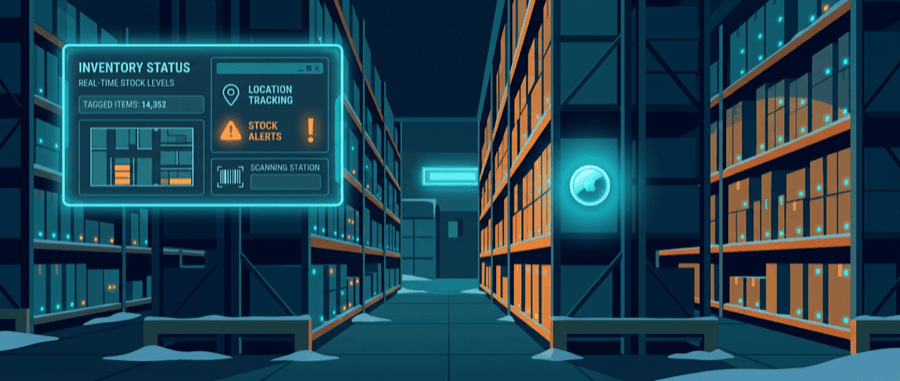
For high-volume warehouses processing tens of thousands of SKUs through predictable chokepoints, RFID inventory tracking delivers genuine ROI. Retailers like Zara and Walmart have proven the math. Cycle counts that took overnight shifts now finish in an hour. Inventory accuracy jumps from 65% to 99%. Stock shrinkage drops measurably.
But 80% of the businesses searching "rfid inventory system" don't operate high-volume warehouses. They run construction companies, field service teams, rental fleets, or mixed operations where assets move between sites. For them, RFID doesn't solve the actual problem. A $29 BLE tag on Apple's Find My network does.
This page breaks down exactly when RFID earns its price tag and when it doesn't.
How RFID Inventory Systems Work
An RFID system has three layers, and each layer adds cost.
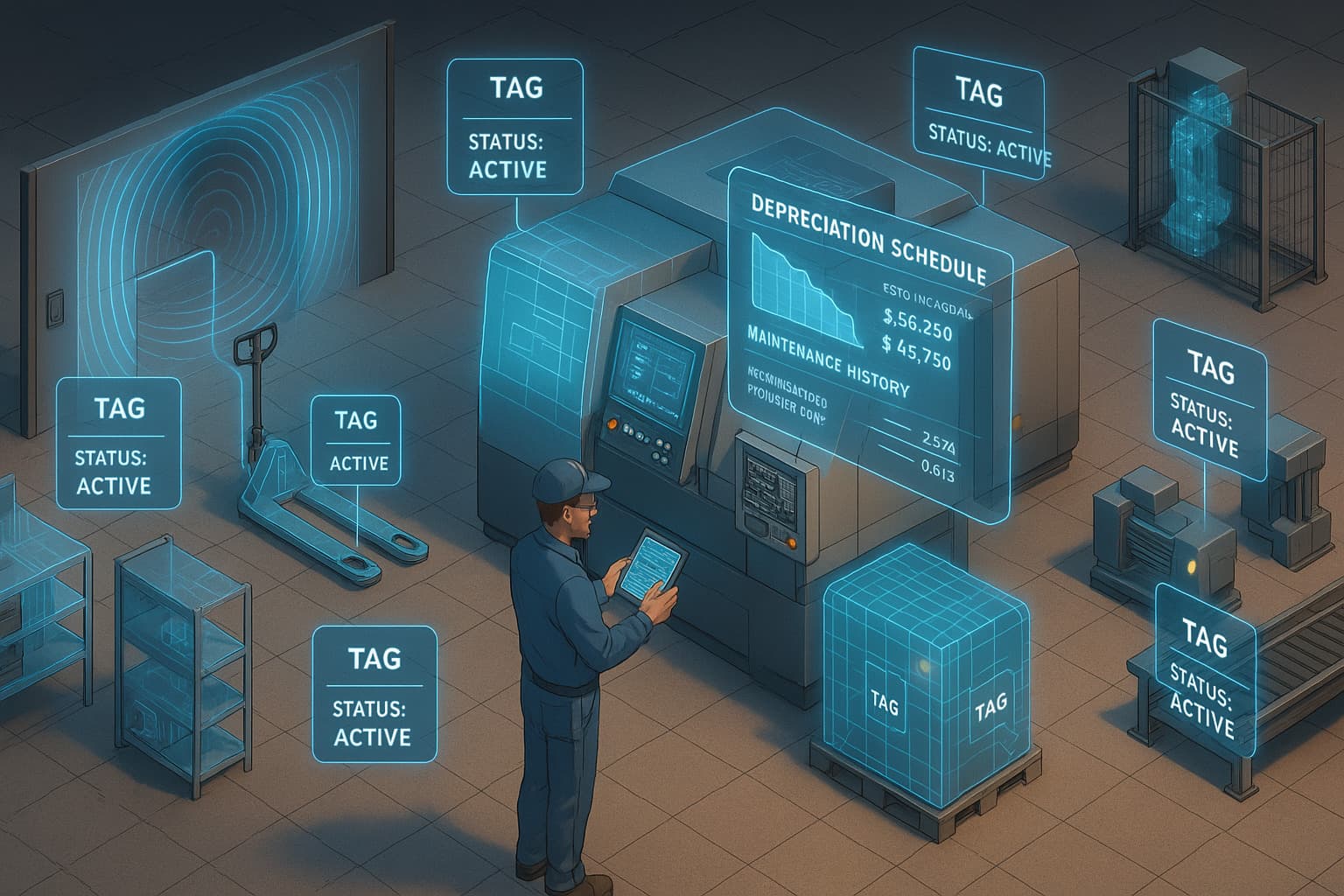
Layer 1: Tags. Small chips with antennas, attached to every item you want to track. Passive tags harvest energy from the reader's radio signal. Active tags carry their own battery. Tags are the cheap part.
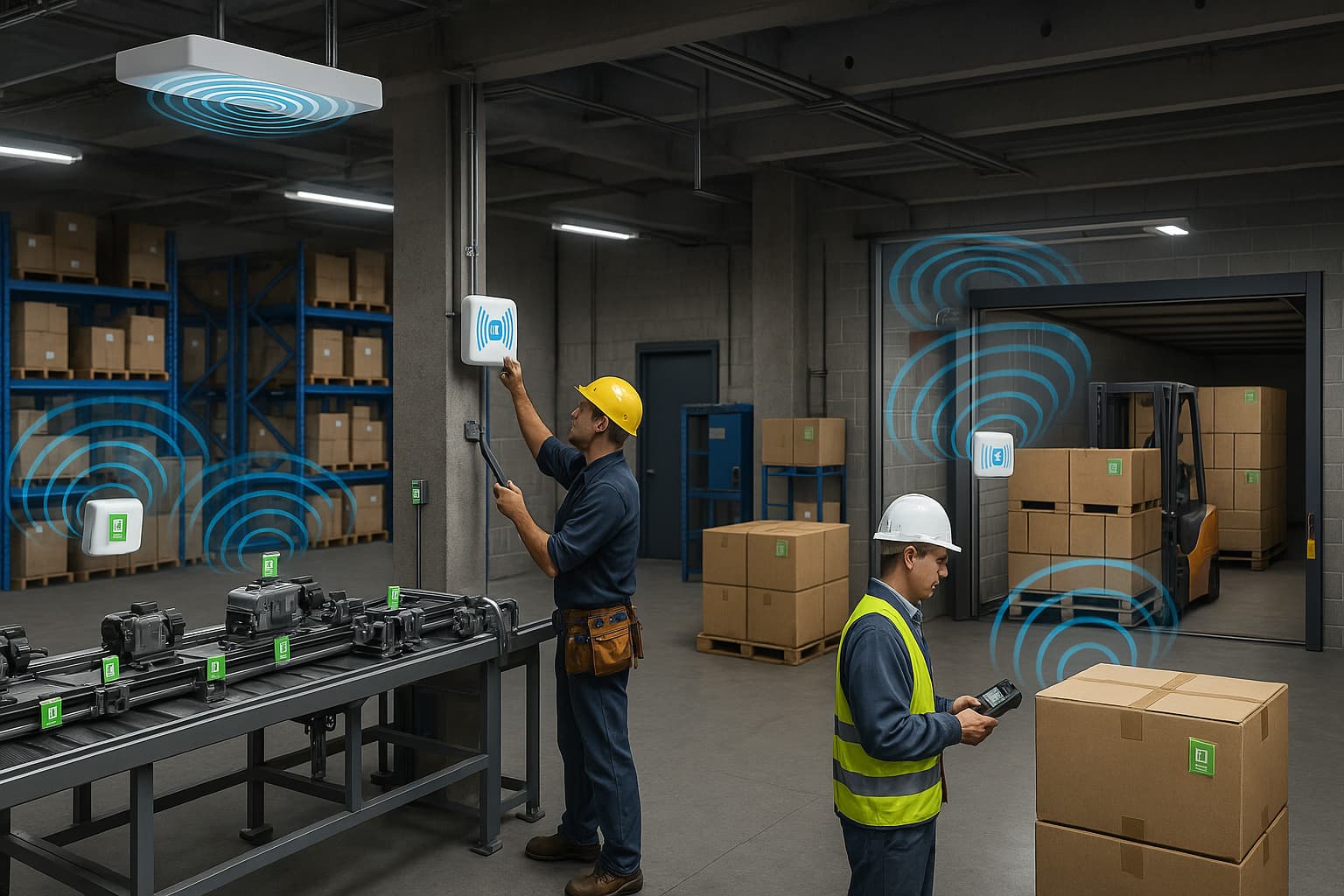
Layer 2: Readers and antennas. Fixed readers mount at doorways, conveyor belts, and staging areas. Handheld readers are carried by workers doing cycle counts. Each reader needs 2-4 antennas to cover its zone. Readers are the expensive part.
Layer 3: Software and middleware. The software translates raw tag reads into inventory data, integrates with your WMS or ERP, and generates reports. Enterprise RFID software licenses run five to six figures per year.
The workflow looks like this: a worker receives a pallet at a dock door. The pallet passes through a portal reader with two antennas. The reader scans 100+ tagged items in 2-3 seconds, compares against the purchase order, and flags discrepancies. No manual scanning. No clipboard. That speed is RFID's real advantage.
The limitation: RFID only knows what happened near a reader. Once that pallet leaves the dock and gets loaded onto a truck, the system goes blind until the pallet passes another reader at another facility. Between readers, your inventory is invisible.
The Full Cost of an RFID Inventory System
RFID vendors quote tag prices because $0.15 sounds cheap. Total system cost tells a different story.
Hardware Costs
| Component | Unit Price | Typical Quantity | Subtotal |
|---|---|---|---|
| Passive UHF tags (bulk) | $0.10-$0.50 | 10,000 | $1,000-$5,000 |
| Fixed readers | $1,000-$3,000 | 8-12 | $8,000-$36,000 |
| Antennas (2-4 per reader) | $100-$500 | 24-48 | $2,400-$24,000 |
| Portal readers (dock doors) | $3,000-$10,000 | 4-6 | $12,000-$60,000 |
| Handheld readers | $1,000-$5,000 | 4-6 | $4,000-$30,000 |
| Cabling and mounting | $200-$500/reader | 12-18 | $2,400-$9,000 |
Hardware subtotal: $30,000-$164,000
Software and Integration
| Component | Annual Cost |
|---|---|
| RFID middleware | $5,000-$20,000/yr |
| Inventory management platform | $10,000-$50,000/yr |
| WMS/ERP integration | $5,000-$30,000 (one-time) |
| Custom development | $10,000-$50,000 (one-time) |
Software subtotal (Year 1): $30,000-$150,000
Implementation
| Service | Cost |
|---|---|
| Site survey and planning | $2,000-$10,000 |
| Installation and calibration | $5,000-$25,000 |
| Training | $2,000-$5,000 |
| Project management | $5,000-$15,000 |
Implementation subtotal: $14,000-$55,000
Total Year 1 Cost by Business Size
| Scale | Year 1 Total | Annual Ongoing |
|---|---|---|
| Small warehouse (5,000 SKUs, 4 readers) | $25,000-$60,000 | $10,000-$25,000 |
| Mid-size operation (25,000 SKUs, 12 readers) | $75,000-$200,000 | $25,000-$60,000 |
| Large enterprise (100,000+ SKUs, multi-site) | $250,000-$750,000+ | $75,000-$200,000 |
Those annual costs aren't optional. Readers fail. Firmware needs updates. Tags need replacement (passive tags last indefinitely, but they get damaged, lost, or removed). Software licenses renew. A 12-reader installation requires dedicated IT support.
When RFID Is the Right Answer
RFID earns its cost in specific conditions. All five of these should be true:
1. High SKU volume. If you're managing 10,000+ unique items, the labor savings from automated counting are substantial. Below 1,000 items, barcodes work fine.
2. Predictable chokepoints. RFID works best when assets flow through doorways, conveyor belts, or staging areas where readers can be mounted. Open-floor environments with unpredictable movement patterns reduce read reliability.
3. Assets stay in your facility. RFID readers have a 30-foot range (passive UHF). Assets that leave your building are invisible to the system. If your assets travel between sites, RFID can't help unless you install readers at every site.
4. You need counting speed, not real-time location. RFID answers "how many?" and "did this item pass here?" It doesn't answer "where is this specific item right now?" without a dense, expensive active RTLS deployment.
5. Budget supports the infrastructure. A minimum viable RFID deployment starts around $25,000. If your tracking budget is under $10,000, RFID isn't on the table.
Industries Where RFID Consistently Delivers ROI
Retail inventory counting. Zara deploys RFID across 2,000+ stores. Store-level inventory accuracy improved from 80% to 98%. Workers count the entire store floor in under an hour. The company reports that RFID-driven accuracy improvements produce measurable revenue gains because fewer stockouts means more items available for sale.
Warehouse receiving and shipping. A pallet of 200 tagged items passes through a portal reader in 3 seconds. Manual barcode scanning takes 20-30 minutes. For distribution centers processing 500+ pallets per day, the labor savings alone justify the system.
Manufacturing work-in-progress. RFID tags embedded in WIP items track progress through production stages automatically. Each time a part passes a reader at a workstation, the system logs the transition. This eliminates manual data entry and gives real-time visibility into production bottlenecks.
Healthcare asset management (within facilities). Hospitals use active RFID to track wheelchairs, infusion pumps, and mobile equipment across floors and departments. Staff spend 20-30 minutes per shift searching for equipment. RFID reduces that to seconds. At nurse hourly rates, the payback is fast.
Aerospace tool accountability. FAA regulations require accounting for every tool that enters and exits an aircraft work zone (FOD prevention). RFID portals at work zone entrances automate this tracking, replacing manual tool counts that take 30+ minutes per shift change.
Sample ROI: RFID in a 50,000 SKU Warehouse
| Category | Amount |
|---|---|
| Year 1 Investment | |
| Hardware (8 readers, 4 portals, 50K tags) | -$85,000 |
| Software and integration | -$45,000 |
| Implementation | -$20,000 |
| Year 1 Savings | |
| Cycle count labor (80% reduction, 6 FTE-equivalent) | +$72,000 |
| Shipping error reduction (90% fewer mis-picks) | +$48,000 |
| Shrinkage reduction (from 3% to 0.5%) | +$65,000 |
| Stockout prevention (15% fewer lost sales) | +$40,000 |
| Net Year 1 | +$75,000 |
| Year 2+ (recurring savings minus annual costs) | +$185,000/yr |
This math works because the warehouse processes enough volume for automated counting to save meaningful labor hours. The same math doesn't work for a 200-asset construction fleet, because construction sites don't have dock doors and portal readers.
When RFID Is Overkill
Most businesses evaluating RFID don't have the use case described above. They have a different problem: "I need to know where my stuff is."
RFID answers "what crossed this checkpoint." If your real question is "where is my excavator," "which job site has our scaffolding," or "where did that pallet end up in the yard," RFID requires blanketing every possible location with readers. That's either impossible or prohibitively expensive for field operations.
Signs RFID Is the Wrong Fit
Your assets move between sites. Construction equipment rotates across job sites. Rental inventory ships to customers and comes back. Field service tools live in trucks. RFID can't track any of this without readers at every possible location.
You have under 1,000 assets. At small scale, RFID's per-item economics don't work. You're spending $25,000-$75,000 in infrastructure to track items that could be managed with $29 BLE tags and a dashboard.
Your assets are outdoors. RFID readers need power, network connectivity, and weather protection. Outdoor deployments add weatherproof enclosures, solar power, cellular backhaul, and exponentially more complexity.
You need real-time location, not checkpoint data. If your question is "where is this right now" rather than "did this pass through the dock door," you're solving a different problem than what RFID is built for.
You don't have dedicated IT support. RFID systems require ongoing maintenance: reader calibration, firmware updates, antenna alignment, network connectivity troubleshooting. Without in-house IT, you're paying vendors $150-$250/hour for support.
You're tracking metal equipment. Standard RFID tags fail on metal surfaces because RF signals reflect off metal. On-metal tags exist but cost 3-10x more and have reduced read range. If most of your assets are steel tools, aluminum equipment, or metal containers, BLE handles the material interference better.
Industries Where RFID Struggles
Construction. Job sites are temporary, open-air, and scattered across a region. Installing RFID infrastructure at each site is impractical. Equipment moves between sites weekly. The "where is it now?" question is more important than "did it pass through a gate?"
Field service. HVAC, plumbing, electrical, and landscaping companies track tools and equipment in service trucks. No fixed chokepoints exist. The tracking need is "which truck has the 300-amp welder?" not "did the welder leave the warehouse?"
Mixed fleets. Companies managing vehicles, trailers, equipment, and tools across multiple locations need one tracking system that works everywhere. RFID only works at instrumented sites.
Rental operations. Equipment gets shipped to customers, used at unknown locations, and returned. RFID can log check-out and check-in, but can't track items during the rental period when visibility matters most.
Multi-site operations without IT staff. A regional contractor with 8 locations doesn't have the IT team to maintain 50+ readers across all sites. The maintenance burden outweighs the tracking value.
The BLE/Find My Alternative: Same Visibility, 1/10th the Cost
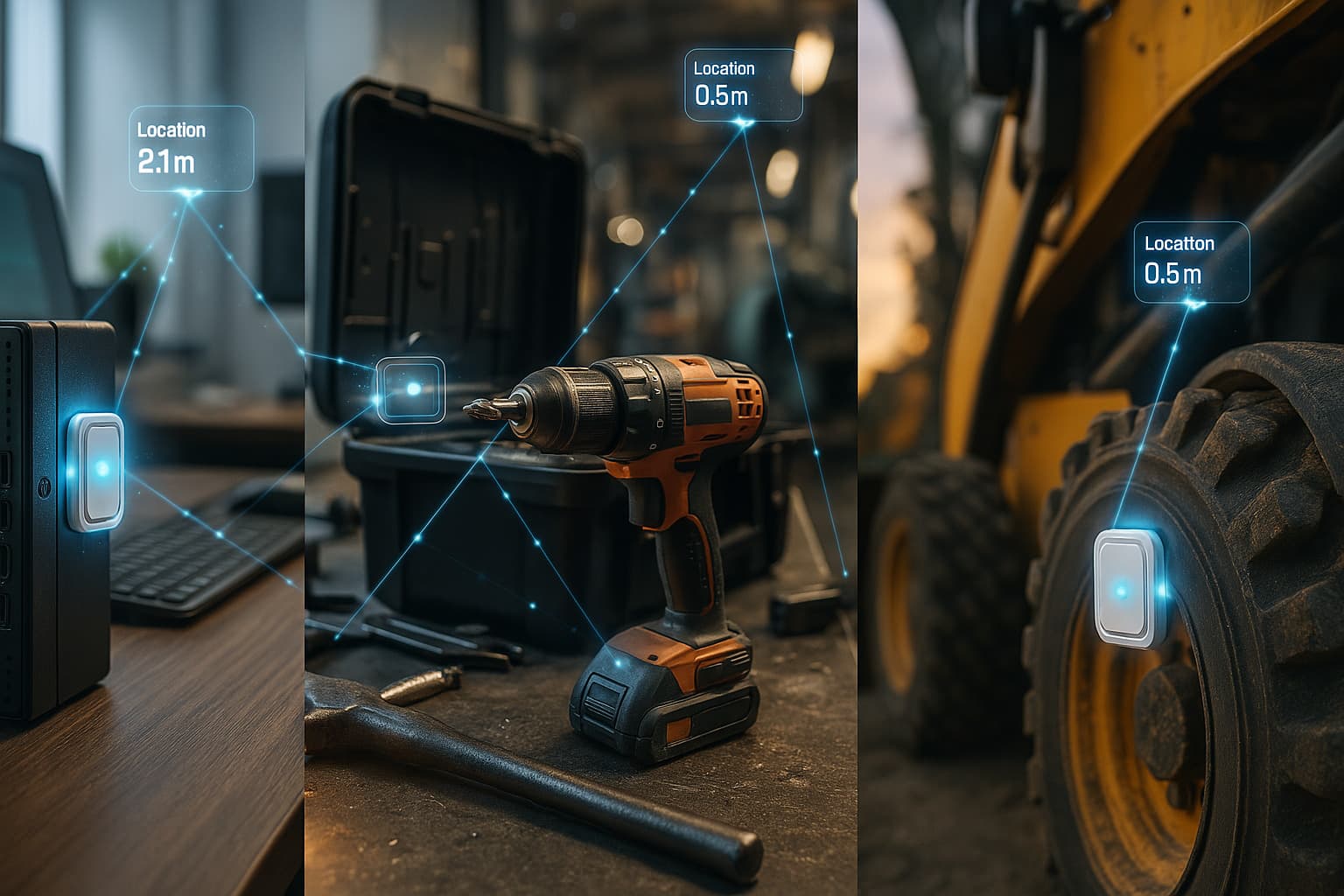
Apple's Find My network turns 2.5 billion iPhones, iPads, and Macs into passive location detectors. A BLE tag broadcasts a Bluetooth signal. Any nearby Apple device picks it up, encrypts the location, and relays it to iCloud. The tag owner sees GPS coordinates on a map.
No readers. No antennas. No middleware. No cabling. No IT support contract.
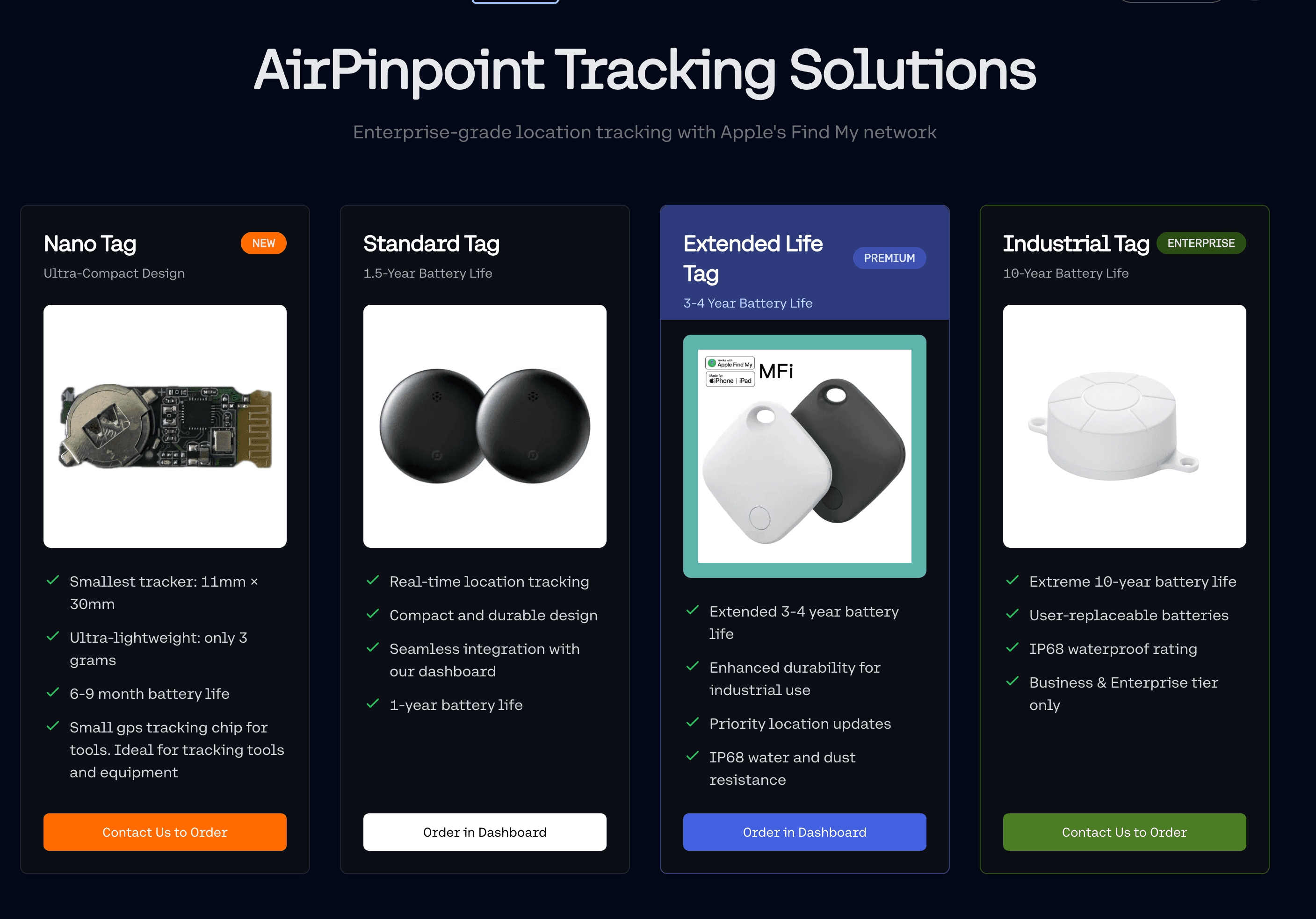
Airpinpoint connects Find My compatible tags to a business dashboard with location history, geofence alerts, team access controls, and API integration.
Cost Comparison: 200 Assets Across 5 Sites
| Category | RFID System | Airpinpoint (BLE/Find My) |
|---|---|---|
| Tags/devices | $1,000 (passive) or $5,000 (active) | $5,800 (200 x $29) |
| Readers (5 sites, 4/site) | $40,000-$60,000 | $0 |
| Antennas | $8,000-$20,000 | $0 |
| Cabling and installation | $10,000-$25,000 | $0 |
| Software (Year 1) | $15,000-$50,000 | $1,188 ($99/mo business plan) |
| Implementation/training | $10,000-$20,000 | Self-service (1 hour) |
| Year 1 Total | $84,000-$180,000 | $6,988 |
| Annual ongoing | $20,000-$55,000 | $1,188 |
What You Get With Each Approach
| Capability | RFID (Passive) | Airpinpoint |
|---|---|---|
| Bulk item counting | 100+ items/second | Manual (scan individually) |
| Real-time location | No (checkpoint only) | Yes (GPS coordinates) |
| Multi-site visibility | Only at instrumented sites | Anywhere Apple devices exist |
| Location history | At reader points only | Continuous trail |
| Geofence alerts | At reader boundaries | Custom polygons, any location |
| Outdoor tracking | Requires weatherproof readers | Works by default |
| Metal compatibility | Poor (special tags needed) | Good |
| Setup time | 2-6 months | Under 1 hour |
| IT requirements | Dedicated support | None |
RFID wins on one dimension: bulk counting speed. If you need to count 10,000 items in 10 minutes, nothing beats a handheld RFID reader walking aisles. BLE can't do that.
Airpinpoint wins on everything else: real-time location, multi-site coverage, outdoor tracking, setup speed, total cost, and maintenance burden.
Decision Framework: RFID vs BLE/Find My
Answer these four questions:
1. What's your primary question?
- "How many items do I have and where are they stocked?" → RFID
- "Where is this specific asset right now?" → BLE/Find My
2. Do your assets stay in one building?
- Yes, always → RFID can work
- No, they move between sites → BLE/Find My
3. How many items are you tracking?
- Over 10,000 SKUs in a warehouse → RFID's bulk scanning pays off
- Under 1,000 mobile assets → BLE/Find My is more cost-effective
4. What's your budget and timeline?
- Over $50K budget, 3-6 month timeline acceptable → RFID is feasible
- Under $10K budget, need tracking this week → BLE/Find My
If you answered "RFID" to all four, deploy RFID. If you answered "BLE/Find My" to even two of them, you'll get better ROI from Airpinpoint.
Many businesses end up with both: RFID for warehouse inventory counting, and Airpinpoint for tracking assets once they leave the facility. The two systems solve different problems and complement each other.
Implementation: What Each Path Looks Like
RFID Implementation Timeline
| Phase | Duration | Activities |
|---|---|---|
| Planning and site survey | 2-4 weeks | Assess facility, map chokepoints, select hardware |
| Procurement | 4-8 weeks | Order readers, antennas, tags, cabling |
| Installation | 2-6 weeks | Mount readers, run cabling, configure network |
| Software setup | 2-4 weeks | Install middleware, integrate with WMS/ERP |
| Testing and calibration | 2-4 weeks | Tune reader sensitivity, test read rates, fix dead zones |
| Training and rollout | 1-2 weeks | Train staff, phase in by zone |
Total: 3-6 months from decision to full operation.
Common delays: reader placement requires trial-and-error tuning because RF behavior varies with shelf materials, inventory density, and ambient interference. Budget for at least two rounds of recalibration.
Airpinpoint Implementation Timeline
| Phase | Duration | Activities |
|---|---|---|
| Setup | 15 minutes | Create account, configure dashboard |
| Tag deployment | 1-3 days | Attach tags to assets, assign in dashboard |
| Team onboarding | 30 minutes | Invite users, set permissions |
| Geofence configuration | 30 minutes | Draw fence polygons on map |
Total: 1-3 days from decision to full operation.
No site survey, no procurement cycle, no cabling, no calibration. Tags broadcast immediately. Locations appear on the dashboard within minutes.
RFID Inventory Systems: The Technology Is Not the Problem
RFID is mature, proven, and genuinely transformative for the right use case. The problem is misapplication. Vendors sell RFID systems to businesses that don't have RFID-shaped problems.
If you process 50,000 SKUs through a distribution center, RFID will save you hundreds of thousands of dollars per year. The infrastructure cost is an investment with documented returns.
If you're tracking 150 pieces of construction equipment across 10 job sites, RFID will cost six figures, take six months to deploy, and still not answer the question you actually have: "Where is my stuff right now?"
The answer to that question costs $29 per asset, works everywhere, and takes an afternoon to set up.
Try Airpinpoint free and see your assets on a map in minutes, no infrastructure required.
 Our Solution